

扫描文档转为可入索引的 Markdown 切块
用 paddleocr-vl 解析扫描件或翻拍文档的每一页,去掉跨页重复的页眉页脚,再把正文切成块:表格整块保留,每块都带着它所在的页码、位置框和标题路径。输出是一个 JSONL 文件,可以直接交给任何嵌入模型和向量库。
模型: paddleocr-vl · 无需密钥: 冒烟运行 · 语言: Python · 在 Playground 中试用 (在新标签页打开) · GitHub 上的源码 (在新标签页打开)
文档搜索索引需要大小合适的文本块,还要能指回文本所在的页。扫描件两样都不给:它是一张图片,常常倾斜、光照不均;单纯倒出一份 OCR 文本,会丢掉让文本块可检索、可引用的结构。
决定代码形态的约束:
- Stack 不提供文本嵌入。 本用例只产出切块,到此为止。请用自己的模型对每个切块的
text做嵌入,把向量与切块的id存在一起。 - API 每次调用只收一页图片。 多页文档就是多次调用,所以页面并发读取(默认同时 2 页),而且一页出错不能拖垮其余页。
- 切块边界决定检索质量。 标题应当开启新块;表格绝不能从中间切开(半张表答不了任何问题);过长的段落在句末切开。
- 页眉页脚是噪声。 每页都有的「Wealth of Nations, Book I」和「Page 2 of 3」会被反复索引,还会匹配到不该匹配的查询。它们跨页重复,所以可以通过比较同一文档的各页找出来。
- 每个命中都要能注明出处。 每个切块保留页码、其中各块的合并框、块的类型和页面文件的 sha256。
- 成本按页计。
paddleocr-vl每页 2 credits,按标价 1,000 页是 2,000 credits。它属于最重的模型级别,所以免费层每分钟只允许处理几页:跑 smoke 页面够用,处理整批文档则不够。
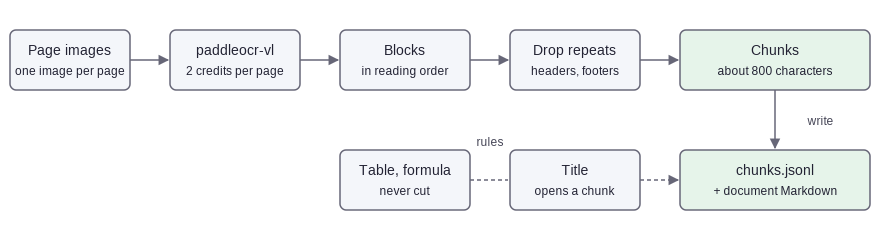
- 取页面图片(数据集就是图片;PDF 要先逐页渲染,见「改成自己的数据」)。
- 使用密钥时,每页上传一次(
POST /v1/images,免费);免费层则把页面以 base64 内联发送。然后用paddleocr-vl和options.blocks: true调用POST /v1/documents/parse:按阅读顺序返回带框的版面块(title、text、table、formula、header、footer等),表格为 HTML,公式为 LaTeX。 - 按
order给块排序。对每份文档,找出文本(数字替换为占位符后)至少在两页出现的header和footer块,并去掉。 - 逐页切块:标题开启新块;正文累积到约 800 个字符,某个块更长时在句末切开;表格和公式绝不切开;一个块不跨页。
- 写出
chunks.jsonl(每行一个切块)、documents/下每份文档一个 Markdown 文件,以及result.json。
一页的输出由 output.schema.json 描述。一个切块长这样:
{"id": "d01-c0002", "document": "d01", "page": 2, "text": "## 2. The pin workshop\n\nTable 1. ...", "chars": 498, "headings": ["The Division of Labour", "2. The pin workshop"], "blockTypes": ["title", "caption", "table"], "bbox": [120, 281, 1119, 884], "blocks": [[2, 1], [2, 2], [2, 3]], "sha256": "..."}各语言的安装与运行
以下命令针对冒烟数据集,在仓库根目录执行。冒烟数据集不需要 API 密钥,在免费层上运行;完整数据集需要密钥,设置上限后,客户端会拒绝可能超出上限的调用。
环境要求: Python 3.12, uv 0.5
cd use-cases/04-documents-to-rag-chunks/pythonuv sync --frozenuv run --frozen python main.py --manifest ../assets/smoke/manifest.json --out out
# 完整数据集: 完整数据集是仓库的发布附件,需要 API 密钥;解压后传入其 manifest。export FOLDBUN_API_KEY="fbs_..."export FOLDBUN_MAX_CREDITS=60uv run --frozen python main.py --manifest ../assets/full.json --out out
# 无需密钥:smoke 运行使用免费层。设置 FOLDBUN_API_KEY 后调用按标价扣费;# FOLDBUN_MAX_CREDITS=4(可选)让客户端拒绝可能超出该额度的调用cd use-cases/04-documents-to-rag-chunks/pythonuv run main.py --out out # 2 张 smoke 页面:按标价 4 credits,在免费层上免费uv run main.py --out out --resume # 中断之后:已读过的页面不再重读uv run main.py --out out --chunk-size 1200 # 换一个目标块大小参数:--manifest、--out、--concurrency(默认 2)、--limit、--resume、--chunk-size(默认 800)、--pdf FILE。输出:result.json(格式见 contract/result.schema.json)、chunks.jsonl、documents/<document>.md,以及 items/(每读完一页存一个小文件,--resume 用它)。
smoke 页面无需密钥即可运行。服务端返回 429 时,客户端按 Retry-After 等待后继续。完整集需要 FOLDBUN_API_KEY:没有密钥时程序以退出码 2 退出并打印标准提示。403 free_tier_unavailable(并非所有地区都提供免费层)是终局错误:该页记为失败,错误信息指向 FOLDBUN_API_KEY。退出码 3 表示密钥无权使用某个模型(403 model_locked),4 表示额度上限。
给一次运行打分:python evaluate.py --result out/result.json --truth assets/smoke/truth.json。
完整集(30 页:15 页干净版和同样 15 页的翻拍版,8 MB)是仓库的发布附件(见 datasets/README.md)。它的清单提交为 assets/full.json,图片和真值在压缩包里。
tar xzf 04-documents-to-rag-chunks-full.tar.gz -C use-cases/04-documents-to-rag-chunks/assetsexport FOLDBUN_API_KEY="fbs_..." # 完整运行需要密钥uv run python -m harness live --size full --uc 04 --max-credits 60 --dry-run # 只看计划,不发任何请求uv run python -m harness refresh --size full --uc 04 --max-credits 60 # 运行、打分,写出 expected/full.json 和 expected/full-summary.json完整清单里,干净版和翻拍版是各自独立的文档(d01 和 d01-photo)。smoke 清单里的两页都属于文档 d01(第 2 页是干净版,第 3 页是翻拍版),所以跨这两页重复的页眉页脚会被去掉。
def idempotency_key(image_sha256: str) -> str: """Same file, same key (at most 128 printable ASCII characters). Within 24 hours the API replays the stored answer for a repeated key without running or charging the call, so a restarted run is free. The key names this program ("py").""" return f"r04-py-{image_sha256}-parse"def parse_page(client: sc.StackClient, image: dict, sha: str, tag: str) -> dict: """One page, one call: layout blocks in reading order and the page as Markdown (2 credits at list price).""" return client.post( "/v1/documents/parse", {"model": MODEL, "image": image, "options": {"blocks": True}}, idempotency_key=idempotency_key(sha), tag=tag, )重试、并发与续跑
Section titled “重试、并发与续跑”重试按页进行,所以一页失败不会拖垮其他页。bad_model_output 表示模型读不了这一页:同一张图会得到同样的失败,因此不重试;这一页记为错误,文档继续处理其余页。
def read_page(client: sc.StackClient, item: dict, base: Path) -> dict: """Read one page. The client already retries what the API marks `retryable`; a page that still fails after that gets two more attempts here, one page at a time, so one bad page never stops the others. `bad_model_output` is not retried (the same image gives the same failure): it is recorded as the page's error and the page is skipped.""" data = (base / item["image"]).read_bytes() sha = hashlib.sha256(data).hexdigest() # With a key the page is uploaded once and every attempt reuses the handle; the free tier takes the bytes inline. image = sc.image_base64(data) if client.free else sc.image_handle(client.upload(data, content_type(item["image"]))["id"]) for attempt in range(1, PAGE_ATTEMPTS + 1): try: page = parse_page(client, image, sha, item["id"]) blocks = [{k: b[k] for k in ("type", "order", "bbox", "text", "markdown") if k in b} for b in page.get("blocks", [])] return { "id": item["id"], "status": "ok", "calls": client.calls(item["id"]), "_sha256": sha, "_page": item["page"], "_document": item["document"], "output": {"markdown": page["markdown"], "blocks": blocks}, } except sc.StackError as err: if err.code in ("model_locked", "budget_exceeded") or err.code == "bad_model_output" or attempt == PAGE_ATTEMPTS or not err.retryable: raise time.sleep(min(2.0 * attempt, 10.0)) raise AssertionError("unreachable")# `--concurrency` pages are in flight (default 2); the client waits out a 429 by itself.code, lock = 0, threading.Lock()with ThreadPoolExecutor(max_workers=args.concurrency) as pool: futures = {pool.submit(read_page, client, item, base): item for item in todo} for future in as_completed(futures): item = futures[future] try: entry = future.result() except sc.StackError as err: print(f"{item['id']}: {err.status} {err.code}: {err.message}" + (f" (request {err.request_id})" if err.request_id else ""), file=sys.stderr) if err.code in ("model_locked", "budget_exceeded"): code = EXIT_TIER if err.code == "model_locked" else EXIT_BUDGET for f in futures: f.cancel() continue entry = { "id": item["id"], "status": "error", "calls": client.calls(item["id"]), "output": None, "error": {"status": err.status, "code": err.code, "message": err.message}, } entries[item["id"]] = entry if entry["status"] == "ok": save_done(args.out, entry) with lock: print(f"{item['id']}: {len(entry['output']['blocks'])} blocks")def item_file(out: Path, item_id: str) -> Path: return out / "items" / f"{item_id}.json"
def load_done(out: Path, item: dict, base: Path) -> dict | None: """The saved entry of a page read by an earlier run of this directory, when the file and the entry format are unchanged.""" path = item_file(out, item["id"]) if not path.exists(): return None saved = json.loads(path.read_text()) key = [hashlib.sha256((base / item["image"]).read_bytes()).hexdigest(), PIPELINE] return saved["entry"] if saved["key"] == key and saved["entry"]["status"] == "ok" else None
def save_done(out: Path, entry: dict): """One small file per page read, written atomically, so a killed run loses at most the pages in flight.""" path = item_file(out, entry["id"]) path.parent.mkdir(parents=True, exist_ok=True) tmp = path.with_suffix(".tmp") tmp.write_text(json.dumps({"key": [entry["_sha256"], PIPELINE], "entry": entry})) os.replace(tmp, path)跨页重复的页眉页脚
Section titled “跨页重复的页眉页脚”源码: python/chunker.py (在新标签页打开)
def furniture_key(block: dict) -> str:    """The text of a header or footer with its digits blanked, so "Page 2 of 3" and "Page 3 of 3" are the same line."""    return re.sub(r"\d+", "#", squash(block.get("text", ""))).lower()
def mark_repeated(pages: list[dict]) -> int:    """Flag the header and footer blocks whose text appears on at least two pages of the document.
`pages` are the successfully read pages of ONE document: {"page": n, "blocks": [...]}. A flagged block gets `dropped: "repeated_header_footer"` and is left out of the chunks and of document.md. A header seen on one page only is kept: nothing says it is page furniture. Returns the number of flagged blocks.""" seen: dict[tuple[str, str], set[int]] = {} for page in pages: for block in page["blocks"]: if block["type"] in FURNITURE and furniture_key(block): seen.setdefault((block["type"], furniture_key(block)), set()).add(page["page"]) flagged = 0 for page in pages: for block in page["blocks"]: block.pop("dropped", None) if block["type"] in FURNITURE and len(seen.get((block["type"], furniture_key(block)), ())) >= 2: block["dropped"] = "repeated_header_footer" flagged += 1 return flagged源码: python/chunker.py (在新标签页打开)
def split_text(text: str, limit: int) -> list[str]: """Pieces of at most `limit` characters, cut at sentence ends; a sentence longer than the limit is cut at a space.""" pieces, cur = [], "" for sentence in SENTENCE.split(text): while len(sentence) > limit: cut = sentence.rfind(" ", 0, limit) cut = cut if cut > 0 else limit if cur: pieces.append(cur) cur = "" pieces.append(sentence[:cut].strip()) sentence = sentence[cut:].strip() if cur and len(cur) + 1 + len(sentence) > limit: pieces.append(cur) cur = "" cur = f"{cur} {sentence}".strip() return pieces + [cur] if cur else pieces源码: python/chunker.py (在新标签页打开)
def chunk_page(blocks: list[dict], page: int, headings: list[tuple[int, str]], target: int = TARGET) -> tuple[list[dict], list[tuple[int, str]]]:    """Chunks of one page. `headings` is the stack of (level, text) the previous pages left open; the new stack is returned.
    - A title closes the chunk in progress and opens a new one, which starts with the heading.    - Text is packed up to `target` characters; a block longer than that is cut at sentence ends first.    - Tables and formulas are never cut. One that does not fit in the chunk in progress starts a new chunk, and a table      longer than `target` is a chunk of its own.    - A chunk never crosses a page boundary, so `page` and `bbox` are exact.    """    chunks: list[dict] = []    cur: dict | None = None
    def flush():        nonlocal cur        if cur and cur["parts"]:            chunks.append(cur)        cur = None
    def open_chunk():        nonlocal cur        cur = {"parts": [], "blocks": [], "types": [], "boxes": [], "headings": [t for _, t in headings]}
    def add(text: str, block: dict):        nonlocal cur        if cur is None:            open_chunk()        cur["parts"].append(text)        if [block["order"]] not in [b[1:] for b in cur["blocks"]]:            cur["blocks"].append([page, block["order"]])        if block["type"] not in cur["types"]:            cur["types"].append(block["type"])        cur["boxes"].append(block["bbox"])
    def size() -> int:        return len("\n\n".join(cur["parts"])) if cur else 0
for block in sorted((b for b in blocks if not b.get("dropped")), key=lambda b: b["order"]): text = block_text(block) if not text: continue if block["type"] == "title": level = heading_level(block) headings = [h for h in headings if h[0] < level] + [(level, squash(block["text"]))] flush() open_chunk() add(text, block) elif block["type"] in ATOMIC: if cur and size() + 2 + len(text) > target: flush() add(text, block) if len(text) > target: flush() else: for piece in split_text(text, target): if cur and size() + 2 + len(piece) > target: flush() add(piece, block) flush() out = [] for c in chunks: xs = [b[0] for b in c["boxes"]], [b[1] for b in c["boxes"]], [b[2] for b in c["boxes"]], [b[3] for b in c["boxes"]] text = "\n\n".join(c["parts"]) out.append( { "page": page, "text": text, "chars": len(text), "headings": c["headings"], "blockTypes": c["types"], "bbox": [min(xs[0]), min(xs[1]), max(xs[2]), max(xs[3])], "blocks": c["blocks"], } ) return out, headingswith (args.out / "chunks.jsonl").open("w") as f: for doc in by_doc: for chunk in chunks_of[doc]: f.write(json.dumps(chunk, ensure_ascii=False) + "\n")数字来自 evaluate.py。文本用归一化编辑距离(NED,0 为完美)评分,对象是除表格和公式外所有块的文本;表格用单元格 F1(行、列和文本都一致才算对);阅读顺序用模型的块顺序与真实顺序之间的 Kendall tau;切块看大小以及有没有表格被切开。每一页都有干净版和翻拍版,所以每项指标也分别给出两种版本。不报告延迟:经客户端网络测得的时间说明不了服务本身的情况。
在记录到线上实测之前,expected/offline.json 里的离线结果只展示流水线在手写应答下的行为,不能说明模型的表现。
smoke 集(2 页):
完整集(30 页):
| 指标 | 数值 |
|---|---|
pages |
30 |
pages_scored |
30 |
pages_failed |
0 |
text_ned |
0.0015 |
table_cell_f1 |
1 |
reading_order_tau |
0.9976 |
text_ned_clean |
0.0018 |
table_cell_f1_clean |
1 |
reading_order_tau_clean |
0.9952 |
text_ned_photographed |
0.0012 |
table_cell_f1_photographed |
1 |
reading_order_tau_photographed |
1 |
formula_recall |
1 |
tables_found_rate |
1 |
text_ned_gap |
-0.0006 |
table_cell_f1_gap |
0 |
chunks |
120 |
chunks_per_page |
4 |
chunk_chars_p10 |
63 |
chunk_chars_p50 |
499 |
chunk_chars_p90 |
758 |
chunk_chars_max |
781 |
tables_in_chunks |
16 |
tables_split |
0 |
blocks_dropped |
85 |
cost_per_1000_pages_list |
2000 |
一页就是一次 paddleocr-vl 调用,2 credits,页面内容是什么都一样:按标价 1,000 页 2,000 credits。表中每 1,000 页成本按每页都是标价计算。smoke 运行在免费层上免费(运行时会打印标价并标注“免费层,不扣费”);带密钥的运行按此扣费。大批量纯文本可以考虑 ppocr-v6,每张图 0.25 credits(见用例 03),但它只返回文字行,没有版面、表格和阅读顺序。
| 运行 | 调用次数 | 标价(credits) | 实扣(credits) |
|---|---|---|---|
| smoke | 2 | 4 | 4 |
| full | 30 | 56 | 56 |
- 失败的调用不扣费;
--resume直接读取items/里已保存的页面、不再调用,所以重跑不会为已读过的页面再付钱。使用密钥时,24 小时内重复的幂等键同样只回放、不扣费。 - 切块在本机运行,不花钱;页面存入
items/之后,改--chunk-size不需要新的调用(配合--resume)。
参见文档里的文档解析 (在新标签页打开)、速率限制 (在新标签页打开)和计费 (在新标签页打开)。
改成自己的数据
Section titled “改成自己的数据”- 自己的页面: 写一份清单,
items[]里每项是{"id", "image", "document", "page"},document把同一份文件的各页归在一起,page是你想在引用里用的页码。没有document时,每张图片是独立的一份文档。 - 自己的 PDF: API 每次调用只收一页图片,所以要先逐页渲染。
python main.py --pdf report.pdf --out out用pypdfium2(用uv sync --extra pdf或pip install pypdfium2安装)按 150 dpi 渲染,把图片写到out/pages/,并把它们当作一份文档处理。main.py的pdf-pages区域就是全部实现;150 dpi 下 A4 页面是 1240 x 1754 px,远低于 OCR 模型接受的 4,096 px。 - 块大小:
--chunk-size。更小的块命中更精确,向量也更多;各嵌入模型擅长处理的长度不同,请按你的模型设置。 - 其他块类型:
figure绝不切开;list和caption按正文处理。 - 嵌入: 这里不计算嵌入。请用自己的模型对
chunk["text"]做嵌入,并把id、document、page和sha256作为向量的元数据保存。
局限与何时不该用
Section titled “局限与何时不该用”- 多栏页面。 单栏内的阅读顺序是可靠的;复杂的多栏期刊版面偶尔顺序会错,这时切块会混栏。数据集上的阅读顺序 tau 只反映集内页面,而它们都是单栏。
- 手写体不在范围内。
- 没有文本嵌入,也没有向量库:只有切块。
- 页眉页脚靠比较去除。 只有一页的文档,或页眉文字每页都变(比如章节标题),不会被判为重复,会留在切块里。
- 切块不跨页。 延续到下一页的段落会成为两个块;代价是页末出现一些较短的块。
- 公式以 LaTeX 返回并整块保留,但模型对公式的识别不一定完全准确。
- 大批量纯文本在不需要表格、公式和阅读顺序时,用
ppocr-v6(每张图 0.25 credits)更便宜。 - 翻拍照片在倾斜、阴影或模糊严重时,识别比干净渲染差;两种版本之间的差距会一并报告。
- 同一张图两次读取的结果可能略有不同。
数据集是合成的,由 datasets/generators/documents.py 生成(CC0):6 份虚构文档,每份 2 到 3 页,用 Pillow 排版,共 15 页,每页都有干净渲染和翻拍变体(透视、旋转、光照不均、模糊、噪点、JPEG),共 30 张、长边不超过 1754 px 的图片。正文节选自公有领域的书(Adam Smith、Charles Darwin、Henry David Thoreau,以及 Albert Einstein 1920 年的英译本);标题、页眉、页脚、表格(数字为虚构,并已注明)和公式都是生成的。每页的真值:按阅读顺序的块及其框、表格单元格,以及整页 Markdown。smoke 集是 d01 的第 2 页(干净版,带表格)和翻拍版的第 3 页。署名:assets/smoke/ATTRIBUTION.csv;来源和许可证:datasets/LICENSES.md。权利人如需移除某张图片或某个数据集,可通过联系页面 (在新标签页打开)提出。