

Scanned documents to Markdown chunks for a search index
Parse every page of a scanned or photographed document with paddleocr-vl, remove the headers and footers that repeat across pages, and cut the text into chunks that keep tables whole and carry the page, the box and the heading path they came from. The output is a JSONL file you can feed to any embedding model and vector store.
Models: paddleocr-vl · Without a key: Smoke run · Languages: Python · Try in Playground (opens in a new tab) · Source on GitHub (opens in a new tab)
Problem
Section titled “Problem”A search index over documents needs text in pieces of a useful size, and a way to point back at the page a piece came from. A scan gives you neither: it is a picture, often tilted and unevenly lit, and a plain OCR text dump loses the structure that makes a piece findable and quotable.
The constraints that shape the code:
- Stack does not provide text embeddings. This use case produces the chunks and stops there. Embed the
textof each chunk with a model of your own and store the vector next to the chunkid. - The API takes one page image per call. A document of many pages is many calls, so pages are read concurrently (2 at a time by default), and one bad page must not stop the rest.
- Chunk boundaries decide retrieval quality. A heading should open a chunk, a table must never be cut in half (half a table answers nothing), and a paragraph that is too long is cut where a sentence ends.
- Running headers and footers are noise. “Wealth of Nations, Book I” and “Page 2 of 3” on every page would be indexed again and again, and would match queries they should not match. They repeat across pages, so they can be found by comparing pages of the same document.
- Every hit must cite its source. Each chunk keeps its page number, the merged box of its blocks, the types of the blocks and the sha256 of the page file.
- Cost is per page.
paddleocr-vlcosts 2 credits per page, so 1,000 pages cost 2,000 credits at list price. It is the heaviest model class, so the free tier allows only a few pages per minute: enough for the smoke pages, not for a corpus.
Pipeline
Section titled “Pipeline”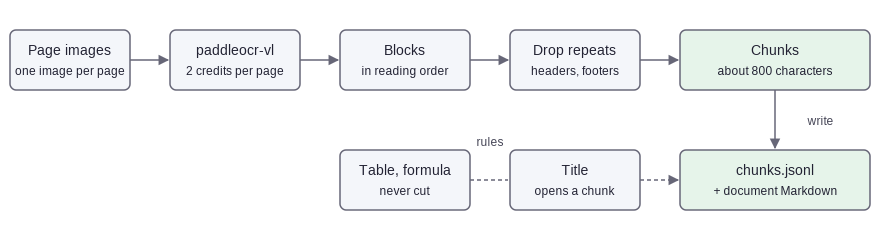
- Take the page images (the dataset is images; for a PDF, render each page first, see “Adapt it”).
- With a key, upload each page once (
POST /v1/images, free); on the free tier send the page inline as base64 instead. Then callPOST /v1/documents/parsewithpaddleocr-vlandoptions.blocks: true: layout blocks (title,text,table,formula,header,footer, …) with boxes, in reading order, tables as HTML and formulas as LaTeX. - Sort the blocks by
order. For every document, find theheaderandfooterblocks whose text (digits blanked) appears on at least two pages and drop them. - Cut chunks page by page: a title starts a new chunk; text is packed to about 800 characters and cut at sentence ends when a block is longer; a table or formula is never cut; a chunk never crosses a page.
- Write
chunks.jsonl(one chunk per line), one Markdown file per document underdocuments/, andresult.json.
The output of one page is described by output.schema.json. A chunk looks like this:
{"id": "d01-c0002", "document": "d01", "page": 2, "text": "## 2. The pin workshop\n\nTable 1. ...", "chars": 498, "headings": ["The Division of Labour", "2. The pin workshop"], "blockTypes": ["title", "caption", "table"], "bbox": [120, 281, 1119, 884], "blocks": [[2, 1], [2, 2], [2, 3]], "sha256": "..."}Run it
Section titled “Run it”Setup and run in each language
Commands for the smoke set, run from the repository root. The smoke set needs no API key: it runs on the free tier. The full set needs a key; the cap makes the client refuse calls that could exceed it.
Requires: Python 3.12, uv 0.5
cd use-cases/04-documents-to-rag-chunks/pythonuv sync --frozenuv run --frozen python main.py --manifest ../assets/smoke/manifest.json --out out
# Full set: the full dataset is a release asset of the repository and needs an API key; unpack it and pass its manifest.export FOLDBUN_API_KEY="fbs_..."export FOLDBUN_MAX_CREDITS=60uv run --frozen python main.py --manifest ../assets/full.json --out out
# no key needed: the smoke run uses the free tier. With FOLDBUN_API_KEY set the calls are charged at list price;# FOLDBUN_MAX_CREDITS=4 (optional) makes the client refuse calls that could pass itcd use-cases/04-documents-to-rag-chunks/pythonuv run main.py --out out # the 2 smoke pages: 4 credits at list price, free on the free tieruv run main.py --out out --resume # after an interruption: pages already read are not read againuv run main.py --out out --chunk-size 1200 # a different target chunk sizeArguments: --manifest, --out, --concurrency (default 2), --limit, --resume, --chunk-size (default 800), --pdf FILE. Outputs: result.json (format of contract/result.schema.json), chunks.jsonl, documents/<document>.md and items/ (one small file per page read, which --resume uses).
The smoke pages run without a key. When the server answers 429 the client waits for Retry-After and carries on. The full set needs FOLDBUN_API_KEY: without it the program exits with code 2 and the standard message. A 403 free_tier_unavailable (the free tier is not offered in every region) is final: the page is recorded as failed with a message that points to FOLDBUN_API_KEY. Exit code 3 means a model locked for the key (403 model_locked) and 4 the credit cap.
To score a run: python evaluate.py --result out/result.json --truth assets/smoke/truth.json.
The full set (30 pages: 15 clean and the same 15 photographed, 8 MB) is a release asset of the repository (see datasets/README.md). Its manifest is committed as assets/full.json; the images and the ground truth are in the archive.
tar xzf 04-documents-to-rag-chunks-full.tar.gz -C use-cases/04-documents-to-rag-chunks/assetsexport FOLDBUN_API_KEY="fbs_..." # the full run needs a keyuv run python -m harness live --size full --uc 04 --max-credits 60 --dry-run # the plan, nothing is sentuv run python -m harness refresh --size full --uc 04 --max-credits 60 # runs, scores, writes expected/full.json and expected/full-summary.jsonIn the full manifest the clean and the photographed copies are separate documents (d01 and d01-photo). In the smoke manifest the two pages both belong to document d01 (page 2 clean, page 3 photographed), so the header and footer that repeat across them are removed.
Idempotency and the call
Section titled “Idempotency and the call”Source: python/main.py (opens in a new tab)
def idempotency_key(image_sha256: str) -> str: """Same file, same key (at most 128 printable ASCII characters). Within 24 hours the API replays the stored answer for a repeated key without running or charging the call, so a restarted run is free. The key names this program ("py").""" return f"r04-py-{image_sha256}-parse"Source: python/main.py (opens in a new tab)
def parse_page(client: sc.StackClient, image: dict, sha: str, tag: str) -> dict: """One page, one call: layout blocks in reading order and the page as Markdown (2 credits at list price).""" return client.post( "/v1/documents/parse", {"model": MODEL, "image": image, "options": {"blocks": True}}, idempotency_key=idempotency_key(sha), tag=tag, )Retries, concurrency and resume
Section titled “Retries, concurrency and resume”One page at a time is retried, so a failing page never stops the others. bad_model_output means the model could not read that page: the same image gives the same failure, so it is not retried; the page is recorded as an error and the document goes on without it.
Source: python/main.py (opens in a new tab)
def read_page(client: sc.StackClient, item: dict, base: Path) -> dict: """Read one page. The client already retries what the API marks `retryable`; a page that still fails after that gets two more attempts here, one page at a time, so one bad page never stops the others. `bad_model_output` is not retried (the same image gives the same failure): it is recorded as the page's error and the page is skipped.""" data = (base / item["image"]).read_bytes() sha = hashlib.sha256(data).hexdigest() # With a key the page is uploaded once and every attempt reuses the handle; the free tier takes the bytes inline. image = sc.image_base64(data) if client.free else sc.image_handle(client.upload(data, content_type(item["image"]))["id"]) for attempt in range(1, PAGE_ATTEMPTS + 1): try: page = parse_page(client, image, sha, item["id"]) blocks = [{k: b[k] for k in ("type", "order", "bbox", "text", "markdown") if k in b} for b in page.get("blocks", [])] return { "id": item["id"], "status": "ok", "calls": client.calls(item["id"]), "_sha256": sha, "_page": item["page"], "_document": item["document"], "output": {"markdown": page["markdown"], "blocks": blocks}, } except sc.StackError as err: if err.code in ("model_locked", "budget_exceeded") or err.code == "bad_model_output" or attempt == PAGE_ATTEMPTS or not err.retryable: raise time.sleep(min(2.0 * attempt, 10.0)) raise AssertionError("unreachable")Source: python/main.py (opens in a new tab)
# `--concurrency` pages are in flight (default 2); the client waits out a 429 by itself.code, lock = 0, threading.Lock()with ThreadPoolExecutor(max_workers=args.concurrency) as pool: futures = {pool.submit(read_page, client, item, base): item for item in todo} for future in as_completed(futures): item = futures[future] try: entry = future.result() except sc.StackError as err: print(f"{item['id']}: {err.status} {err.code}: {err.message}" + (f" (request {err.request_id})" if err.request_id else ""), file=sys.stderr) if err.code in ("model_locked", "budget_exceeded"): code = EXIT_TIER if err.code == "model_locked" else EXIT_BUDGET for f in futures: f.cancel() continue entry = { "id": item["id"], "status": "error", "calls": client.calls(item["id"]), "output": None, "error": {"status": err.status, "code": err.code, "message": err.message}, } entries[item["id"]] = entry if entry["status"] == "ok": save_done(args.out, entry) with lock: print(f"{item['id']}: {len(entry['output']['blocks'])} blocks")Source: python/main.py (opens in a new tab)
def item_file(out: Path, item_id: str) -> Path:    return out / "items" / f"{item_id}.json"
def load_done(out: Path, item: dict, base: Path) -> dict | None:    """The saved entry of a page read by an earlier run of this directory, when the file and the entry format are unchanged."""    path = item_file(out, item["id"])    if not path.exists():        return None    saved = json.loads(path.read_text())    key = [hashlib.sha256((base / item["image"]).read_bytes()).hexdigest(), PIPELINE]    return saved["entry"] if saved["key"] == key and saved["entry"]["status"] == "ok" else None
def save_done(out: Path, entry: dict):    """One small file per page read, written atomically, so a killed run loses at most the pages in flight."""    path = item_file(out, entry["id"])    path.parent.mkdir(parents=True, exist_ok=True)    tmp = path.with_suffix(".tmp")    tmp.write_text(json.dumps({"key": [entry["_sha256"], PIPELINE], "entry": entry}))    os.replace(tmp, path)
Headers and footers that repeat
Section titled “Headers and footers that repeat”Source: python/chunker.py (opens in a new tab)
def furniture_key(block: dict) -> str:    """The text of a header or footer with its digits blanked, so "Page 2 of 3" and "Page 3 of 3" are the same line."""    return re.sub(r"\d+", "#", squash(block.get("text", ""))).lower()
def mark_repeated(pages: list[dict]) -> int:    """Flag the header and footer blocks whose text appears on at least two pages of the document.
    `pages` are the successfully read pages of ONE document: {"page": n, "blocks": [...]}. A flagged block gets    `dropped: "repeated_header_footer"` and is left out of the chunks and of document.md. A header seen on one page    only is kept: nothing says it is page furniture. Returns the number of flagged blocks."""    seen: dict[tuple[str, str], set[int]] = {}    for page in pages:        for block in page["blocks"]:            if block["type"] in FURNITURE and furniture_key(block):                seen.setdefault((block["type"], furniture_key(block)), set()).add(page["page"])    flagged = 0    for page in pages:        for block in page["blocks"]:            block.pop("dropped", None)            if block["type"] in FURNITURE and len(seen.get((block["type"], furniture_key(block)), ())) >= 2:                block["dropped"] = "repeated_header_footer"                flagged += 1    return flagged
Chunking
Section titled “Chunking”Source: python/chunker.py (opens in a new tab)
def split_text(text: str, limit: int) -> list[str]: """Pieces of at most `limit` characters, cut at sentence ends; a sentence longer than the limit is cut at a space.""" pieces, cur = [], "" for sentence in SENTENCE.split(text): while len(sentence) > limit: cut = sentence.rfind(" ", 0, limit) cut = cut if cut > 0 else limit if cur: pieces.append(cur) cur = "" pieces.append(sentence[:cut].strip()) sentence = sentence[cut:].strip() if cur and len(cur) + 1 + len(sentence) > limit: pieces.append(cur) cur = "" cur = f"{cur} {sentence}".strip() return pieces + [cur] if cur else piecesSource: python/chunker.py (opens in a new tab)
def chunk_page(blocks: list[dict], page: int, headings: list[tuple[int, str]], target: int = TARGET) -> tuple[list[dict], list[tuple[int, str]]]:    """Chunks of one page. `headings` is the stack of (level, text) the previous pages left open; the new stack is returned.
    - A title closes the chunk in progress and opens a new one, which starts with the heading.    - Text is packed up to `target` characters; a block longer than that is cut at sentence ends first.    - Tables and formulas are never cut. One that does not fit in the chunk in progress starts a new chunk, and a table      longer than `target` is a chunk of its own.    - A chunk never crosses a page boundary, so `page` and `bbox` are exact.    """    chunks: list[dict] = []    cur: dict | None = None
    def flush():        nonlocal cur        if cur and cur["parts"]:            chunks.append(cur)        cur = None
    def open_chunk():        nonlocal cur        cur = {"parts": [], "blocks": [], "types": [], "boxes": [], "headings": [t for _, t in headings]}
    def add(text: str, block: dict):        nonlocal cur        if cur is None:            open_chunk()        cur["parts"].append(text)        if [block["order"]] not in [b[1:] for b in cur["blocks"]]:            cur["blocks"].append([page, block["order"]])        if block["type"] not in cur["types"]:            cur["types"].append(block["type"])        cur["boxes"].append(block["bbox"])
    def size() -> int:        return len("\n\n".join(cur["parts"])) if cur else 0
for block in sorted((b for b in blocks if not b.get("dropped")), key=lambda b: b["order"]): text = block_text(block) if not text: continue if block["type"] == "title": level = heading_level(block) headings = [h for h in headings if h[0] < level] + [(level, squash(block["text"]))] flush() open_chunk() add(text, block) elif block["type"] in ATOMIC: if cur and size() + 2 + len(text) > target: flush() add(text, block) if len(text) > target: flush() else: for piece in split_text(text, target): if cur and size() + 2 + len(piece) > target: flush() add(piece, block) flush() out = [] for c in chunks: xs = [b[0] for b in c["boxes"]], [b[1] for b in c["boxes"]], [b[2] for b in c["boxes"]], [b[3] for b in c["boxes"]] text = "\n\n".join(c["parts"]) out.append( { "page": page, "text": text, "chars": len(text), "headings": c["headings"], "blockTypes": c["types"], "bbox": [min(xs[0]), min(xs[1]), max(xs[2]), max(xs[3])], "blocks": c["blocks"], } ) return out, headingsSource: python/main.py (opens in a new tab)
with (args.out / "chunks.jsonl").open("w") as f: for doc in by_doc: for chunk in chunks_of[doc]: f.write(json.dumps(chunk, ensure_ascii=False) + "\n")Results
Section titled “Results”The numbers come from evaluate.py. Text is scored as the normalised edit distance (NED, 0 is perfect) of the text of all blocks except tables and formulas; tables as the F1 of their cells (a cell counts when its row, column and text match); reading order as the Kendall tau between the model’s block order and the true order; and the chunks by their size and by whether any table was cut. Every page exists as a clean render and as a photographed variant, so each metric is also given per variant. No latency is reported: a time measured through a client’s network says little about the service.
Until a live run is recorded the offline result in expected/offline.json shows how the pipeline behaves with hand-written answers; it says nothing about the model.
Smoke set (2 pages):
Full set (30 pages):
| Metric | Value |
|---|---|
pages |
30 |
pages_scored |
30 |
pages_failed |
0 |
text_ned |
0.0015 |
table_cell_f1 |
1 |
reading_order_tau |
0.9976 |
text_ned_clean |
0.0018 |
table_cell_f1_clean |
1 |
reading_order_tau_clean |
0.9952 |
text_ned_photographed |
0.0012 |
table_cell_f1_photographed |
1 |
reading_order_tau_photographed |
1 |
formula_recall |
1 |
tables_found_rate |
1 |
text_ned_gap |
-0.0006 |
table_cell_f1_gap |
0 |
chunks |
120 |
chunks_per_page |
4 |
chunk_chars_p10 |
63 |
chunk_chars_p50 |
499 |
chunk_chars_p90 |
758 |
chunk_chars_max |
781 |
tables_in_chunks |
16 |
tables_split |
0 |
blocks_dropped |
85 |
cost_per_1000_pages_list |
2000 |
One page is one paddleocr-vl call at 2 credits, whatever the page contains: 2,000 credits per 1,000 pages at list price. The cost per 1,000 pages in the table is computed with every page at list price. A smoke run is free on the free tier (the run prints its list price labelled “free tier, not charged”); a keyed run costs this much. For large batches of plain text, ppocr-v6 costs 0.25 credits per image (see use case 03) but returns lines without layout, tables or reading order.
| Run | Calls | List price (credits) | Charged (credits) |
|---|---|---|---|
| smoke | 2 | 4 | 4 |
| full | 30 | 56 | 56 |
- A call that fails is not charged, and
--resumereads the pages already saved initems/instead of calling again, so reruns cost nothing for pages already read. With a key, a repeated idempotency key within 24 hours is also replayed without being charged. - Chunking runs on your machine and costs nothing; changing
--chunk-sizeneeds no new calls once the pages are saved initems/(use--resume).
See Document parsing (opens in a new tab), Rate limits (opens in a new tab) and Billing (opens in a new tab) in the documentation.
Adapt it
Section titled “Adapt it”- Your own pages: write a manifest with
items[]of{"id", "image", "document", "page"}, wheredocumentgroups the pages of one file andpageis the page number you want in citations. Withoutdocumentevery image is its own document. - Your own PDFs: the API takes one page image per call, so render the pages first.
python main.py --pdf report.pdf --out outdoes it withpypdfium2(install it withuv sync --extra pdforpip install pypdfium2) at 150 dpi, writes the images toout/pages/and processes them as one document. Thepdf-pagesregion ofmain.pyis the whole of it; at 150 dpi an A4 page is 1240 x 1754 px, well under the 4,096 px that the OCR models accept. - Chunk size:
--chunk-size. A smaller size gives more precise hits and more vectors; embedding models differ in the length they handle well, so set it from yours. - Other block types:
figureis never cut;listandcaptionare treated as text. - Embeddings: none are computed here. Embed
chunk["text"]with your own model and keepid,document,pageandsha256as the metadata of the vector.
Limits and when not to use this
Section titled “Limits and when not to use this”- Multi-column pages. Reading order inside a single column is reliable; complex multi-column journal layouts sometimes come back in the wrong order, and then chunks mix columns. The reading-order tau on the set shows it only for the pages in it, which are single-column.
- Handwriting is out of scope.
- No text embeddings and no vector store: only chunks.
- Headers and footers are removed by comparison. A document with a single page, or a header whose text changes on every page (a chapter title), is not detected as repeating and stays in the chunks.
- Chunks do not cross pages. A paragraph that continues on the next page is two chunks; the cost is some short chunks at the end of a page.
- Formulas come back as LaTeX and are kept whole, but the model’s reading of a formula is not always exact.
- Large plain-text batches are cheaper with
ppocr-v6(0.25 credits per image) when you do not need tables, formulas or reading order. - Photographs with strong tilt, shadow or blur read worse than clean renders; the gap between the two variants is reported.
- Two readings of the same image can differ slightly between runs.
The set is synthetic and made by datasets/generators/documents.py (CC0): six fictional documents of 2 to 3 pages, laid out with Pillow, 15 pages in all, each as a clean render and as a photographed variant (perspective, rotation, uneven light, blur, noise, JPEG), 30 images of up to 1754 px. The body text is excerpted from public-domain books (Adam Smith, Charles Darwin, Henry David Thoreau, Albert Einstein in the 1920 translation); the headings, running headers, footers, tables (invented figures, labelled as such) and formulas are generated. Ground truth per page: the blocks in reading order with boxes, the table cells and the page as Markdown. The smoke set is page 2 of d01 (clean, with a table) and page 3 of the photographed variant. Attribution: assets/smoke/ATTRIBUTION.csv; sources and licences: datasets/LICENSES.md. Rights holders can request removal of an image or dataset through the contact page (opens in a new tab).