

Document parsing
Document parsing finds the layout blocks of a page (text, title, table, formula, figure and more), recognises each block, and returns the blocks in reading order together with the whole page as Markdown. Tables are written as HTML tables and formulas as LaTeX. Typical uses are invoices, papers, reports and book pages that are converted to structured text. One request is one page image. Multi-page PDF input is not available yet. To read plain lines from a screenshot or a crop, see Text recognition (OCR).
Layout blocks and reading order
Section titled “Layout blocks and reading order”Every region of the page is returned as an entry of blocks with a type, an order, a bbox, and the recognised text and markdown. The type is one of text, title, table, formula, figure, caption, header, footer, list and other. order is the reading order, from 0, as the model determines it; the page below is read column by column. The markdown field of the response joins the blocks in that order.
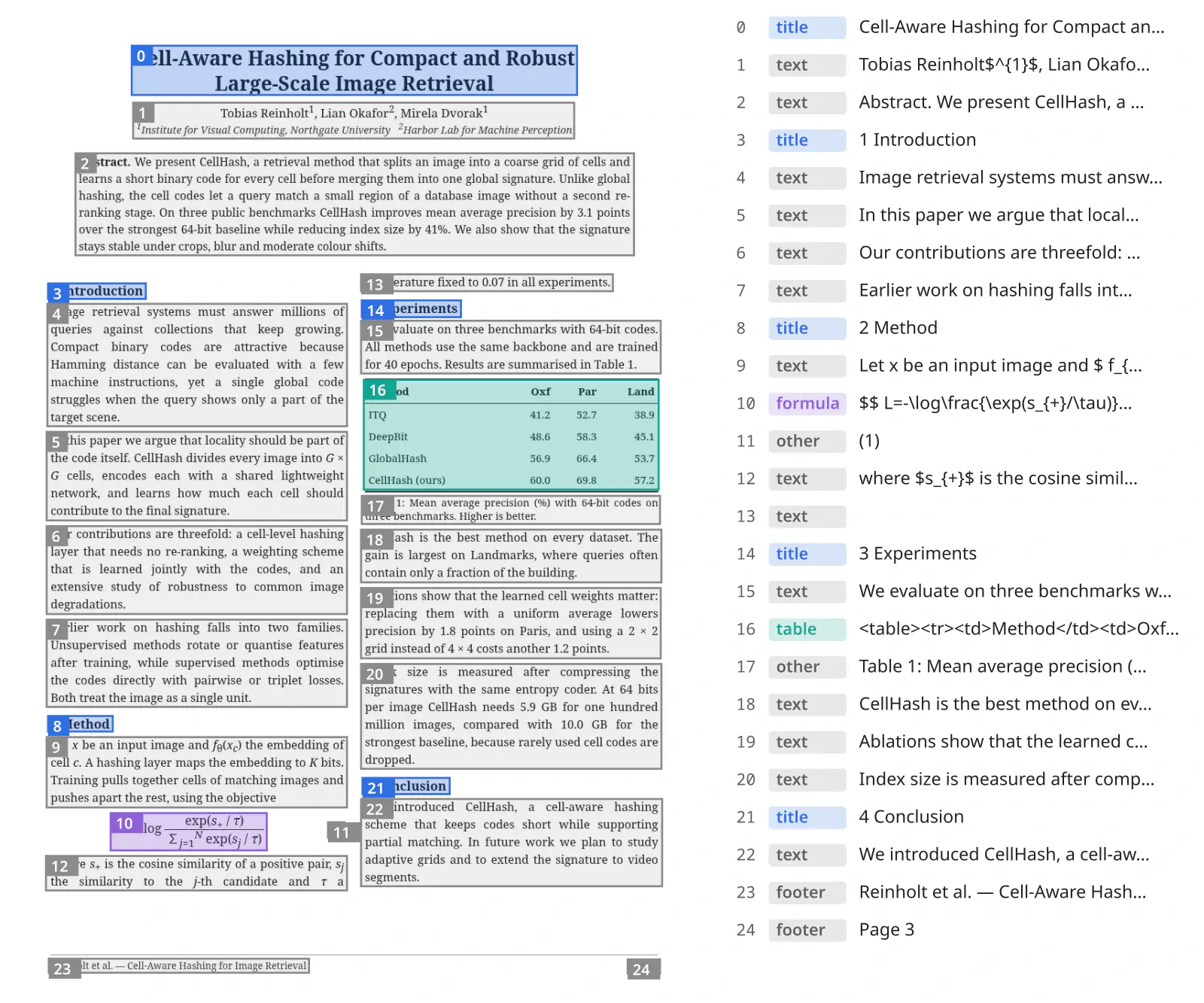
Recorded Playground result for a two-column paper page. The numbers are order; the list on the right shows type and the start of text, with a title, text, a formula, a table and a footer among the 25 blocks.
With options.blocks set to false, blocks is omitted and only markdown is returned.
Tables as HTML
Section titled “Tables as HTML”A block of type table holds the table as an HTML <table>, in both text and markdown, so that rows, columns and header cells survive and the table can be rendered or parsed directly.
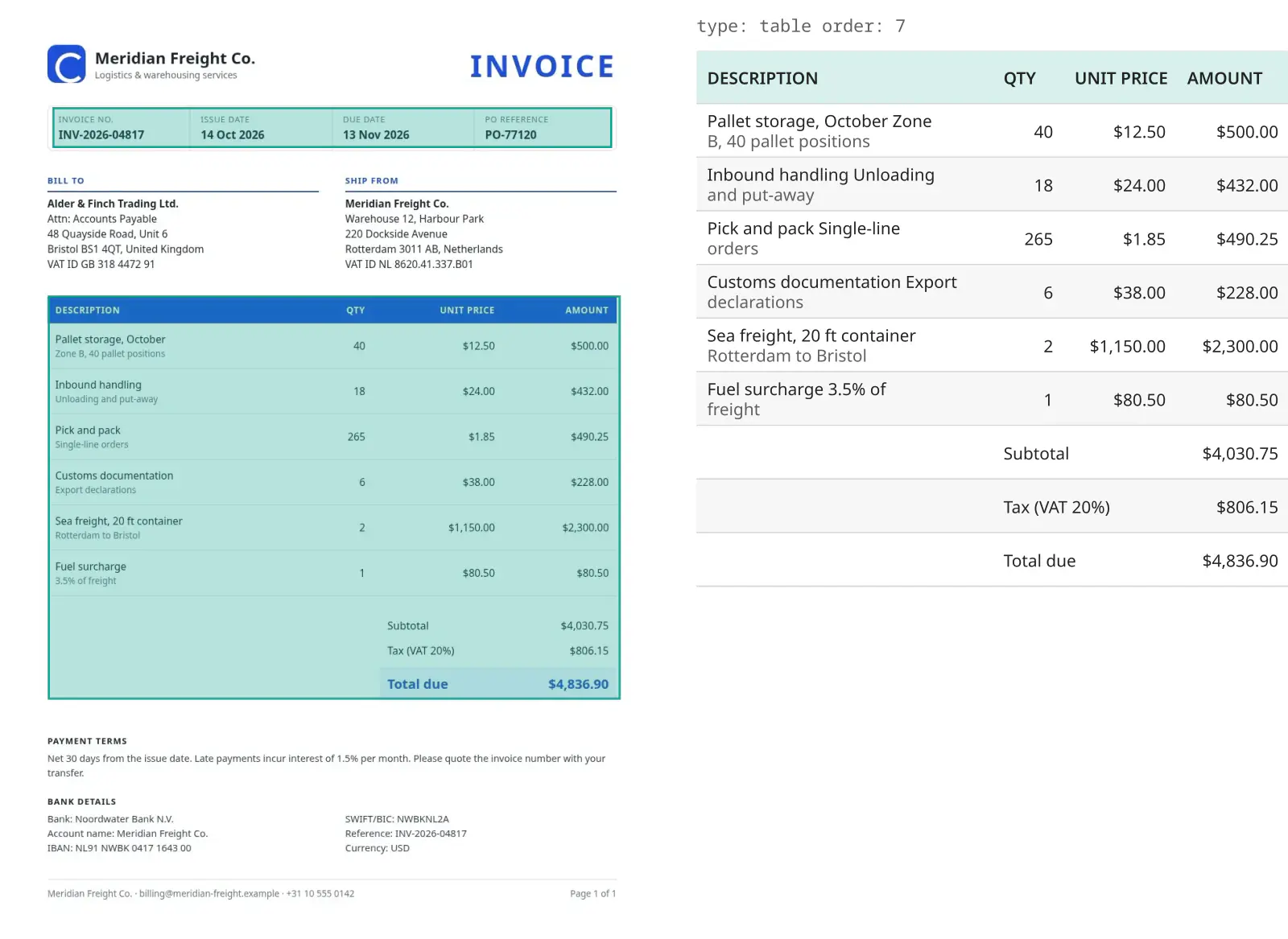
Recorded Playground result for an invoice. The teal boxes are blocks of type table; the right side is the HTML of the block with order 7, rendered.
Formulas as LaTeX
Section titled “Formulas as LaTeX”A block of type formula holds a display formula as LaTeX, delimited by $$. Formulas that sit inside a line of running text stay in the text and markdown of that block, delimited by $.
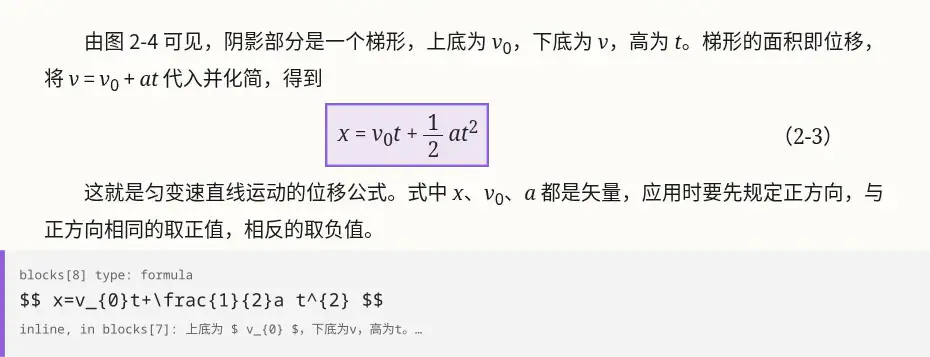
Recorded Playground result for a textbook page. The boxed display formula is a block of type formula; the recognised LaTeX is shown below the page, with an inline formula from an adjacent text block.
Supported models
Section titled “Supported models”paddleocr-vl is the default and only model of POST /v1/documents/parse.
paddleocr-vlis the model for documents: typed blocks with boxes, reading order, tables as HTML, formulas as LaTeX and a Markdown version of the page. It is billed per page and available from the paid pool only.ppocr-v6returns plain lines and word boxes without layout, reading order, tables or formulas. It is the low-cost choice for screenshots, crops and copy-text OCR. The table that compares the two is on Text recognition (OCR).
Example call
Section titled “Example call”One invoice page sent to POST /v1/documents/parse with layout blocks:
curl https://api.stack.foldbun.com/v1/documents/parse \ -H "Authorization: Bearer $FOLDBUN_API_KEY" \ -H "Content-Type: application/json" \ -d '{ "model": "paddleocr-vl", "image": { "id": "img_e0100380a624332f4161c651ea355c84914159eaa064df2db226519dadb944e7" }, "options": { "blocks": true } }'The response is abridged: the page has more blocks and a longer Markdown string.
{ "id": "call_01a1913d-e9ef-767e-8ca1-f490b0af5533", "model": "paddleocr-vl", "image": { "id": "img_e0100380a624332f4161c651ea355c84914159eaa064df2db226519dadb944e7", "width": 1008, "height": 1426, "bytes": 143151, "contentType": "image/jpeg" }, "pages": 1, "markdown": "INVOICE\n\n<table>...</table>\n\n## BILL TO\n\nAlder & Finch Trading Ltd.\n...", "blocks": [ { "type": "header", "order": 1, "bbox": [710, 76, 933, 124], "text": "INVOICE", "markdown": "INVOICE" }, { "type": "table", "order": 2, "bbox": [81, 164, 928, 223], "text": "<table><tr><td>INVOICE NO.</td><td>ISSUE DATE</td></tr><tr><td>INV-2026-04817</td><td>14 Oct 2026</td></tr></table>", "markdown": "<table><tr><td>INVOICE NO.</td><td>ISSUE DATE</td></tr><tr><td>INV-2026-04817</td><td>14 Oct 2026</td></tr></table>" } ], "cost": 2, "balance": 996, "timing": { "queueMs": 0, "processingMs": 1294 }, "billing": { "lines": [ { "unit": "page", "quantity": 1, "unitPrice": 2, "amount": 2, "waived": false } ], "total": 2, "charged": true, "pool": null }}Reading the response
Section titled “Reading the response”pagesis 1: a request is one page image.markdownis the whole page in reading order, with tables as HTML.blocksholds one entry per layout region; the JSON shows two of them.typeisheaderandtablehere,orderis the reading order,bboxis[x1, y1, x2, y2]in pixels of the oriented original, 1008 × 1426 here (image.width,image.height).textis the recognised text of the block. Thetableblock holds an HTML<table>in bothtextandmarkdown.billing.chargedistrueandpoolisnull: the call was debited from the balance, socostis 2.
All fields: API reference.
Cost of this call. 2 (page) credits per call, whatever the number of blocks, as charged in this response. Unit prices: Billing.
Endpoints and reference
Section titled “Endpoints and reference”| Endpoint | In this use case | Reference |
|---|---|---|
POST /v1/documents/parse |
One page image to ordered blocks, HTML tables, LaTeX formulas and the page as Markdown | API reference |
POST /v1/ocr |
Plain lines and word boxes instead of structure | API reference |
paddleocr-vl: how the model works, its limits and measured latency.- Billing:
paddleocr-vlbills onepageper call. - Text recognition (OCR): plain lines and word boxes with
ppocr-v6, and the comparison of both models.