

监控线上集成的成本与时延
用一个监控层包住客户端文件,把每次应答里的计费和耗时变成 Prometheus 指标(按模型和单位的 credits、按结果分类的调用数、编码缓存命中及省下的费用、排队和处理耗时、以及密钥的余额),并在预算花完之前触发花费守卫。除了可选的、免费的 GET /v1/whoami,不需要向 API 多要任何东西。
模型: ppocr-v6, sam-lite, sam3 · 无需密钥: 冒烟运行 · 语言: Python · 在 Playground 中试用 (在新标签页打开) · GitHub 上的源码 (在新标签页打开)
一个上线当天正常的集成,到了线上也可能在没有任何报错的情况下出问题:某个循环反复发送同一张图,提示词从每次 1 个涨到 10 个,批处理任务的规模翻倍,或者别人都在用的时候某个模型的排队时间悄悄变长。API 在每次应答里已经给了你需要的一切,但只针对那一次调用。你真正想要的是随时间变化的几个数字,以及数字异常时有人收到通知:
- 每小时多少 credits,按模型、按单位(
image、prompt、encode_image……)拆开,其中有多少是真正从密钥扣掉的,有多少在免费层上免费运行; - SAM 调用有多少次复用了已经编码过的图片(缓存命中时免收编码费),省下了多少;
- 调用在队列里等了多久、处理了多久,按服务器的测量;
- 账户还剩多少(使用密钥时),余额快没了就报警;最近一小时的花费不正常时,拒绝继续发调用。
本例是这个监控层的 Python 版:一个文件 monitoring.py,复制到 stack_client.py 旁边就能用。它不修改客户端文件,而是包住一个客户端对象,读取每次应答(cost、billing、cache、timing、balance、错误码),批处理则读取每个 item 事件。用 21 次调用的回放(assets/workload.jsonl)端到端跑一遍,并检查指标和客户端自己的账本是否一致。
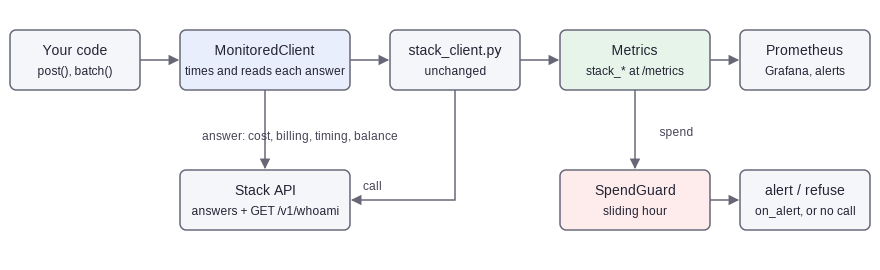
| 步骤 | 做什么 | 端点 |
|---|---|---|
| 包装 | MonitoredClient(StackClient(), Monitor(guard=...)):post 和 batch 被度量,其余一律转发 |
无 |
| 调用 | 被包住的客户端照常发送:重试、节流、幂等和额度上限都是客户端的事 | POST /v1/ocr、/v1/segment ……、POST /v1/batch/* |
| 读取 | 按 billing.lines[] 记 credits,读 cost、cache、timing.queueMs / processingMs、balance;错误按 code 计数 |
无 |
| 守卫 | 把最近一小时的花费与上限比较;每次越线报警一次,或拒绝新调用 | 无 |
| 刷新 | refresh_account() 读取密钥的余额,免费层则读取今天的使用量和每个重量级的每日上限;放在定时器里调用,refresh_every(client, 60) 就是这样 |
GET /v1/whoami(免费,不计量) |
| 暴露 | monitor.serve(9108) 提供 GET /metrics;Prometheus 抓取,Grafana 和告警规则读取 |
无 |
指标,全部以 stack_ 开头:
| 指标 | 标签 | 来源 |
|---|---|---|
stack_credits_total |
model、unit、charged |
billing.lines[] 的每一行;charged="false" 是在免费层上免费运行的工作的标价;异步作业的每个条目按它自己的成本(标价的十分之一)计入 async_<unit>,例如 async_image |
stack_calls_total |
model、status、code |
status 为 ok、replayed、error、expired 或 refused(没有发出:额度上限或守卫);code 是 API 错误码,ok 时为 none |
stack_async_jobs_total |
model、status |
到达终态的异步作业(completed、partial、failed、cancelled 或 expired),每个作业只计一次;第一个作业出现后该指标才存在 |
stack_cache_hits_total、stack_cache_misses_total |
model |
SAM 应答的 cache |
stack_cache_saved_credits_total |
model |
waived: true 的行的标价 |
stack_latency_ms(直方图) |
model、phase |
queue 和 processing 来自 timing;client_total 是本进程在调用外围测到的时间,供你自己的看板使用 |
stack_balance_credits、stack_balance_updated_timestamp_seconds |
最近一次应答或 whoami 刷新的 balance,以及更新时刻 |
|
stack_free_used_today、stack_free_daily_limit |
class |
仅免费层:本项目今天的调用数和每个重量级的每日上限,来自 whoami 刷新 |
stack_spend_window_credits、stack_spend_guard_tripped |
守卫的窗口花费,以及是否越线 |
各语言的安装与运行
以下命令针对冒烟数据集,在仓库根目录执行。冒烟数据集不需要 API 密钥,在免费层上运行;完整数据集需要密钥,设置上限后,客户端会拒绝可能超出上限的调用。
环境要求: Python 3.12, uv 0.5
cd use-cases/08-cost-and-latency-monitoring/pythonuv sync --frozenuv run --frozen python main.py --manifest ../assets/manifest.json --out out
# 完整数据集: 完整数据集是仓库的发布附件,需要 API 密钥;解压后传入其 manifest。export FOLDBUN_API_KEY="fbs_..."export FOLDBUN_MAX_CREDITS=2.75uv run --frozen python main.py --manifest ../assets/manifest.json --out out
# 无需密钥:回放在免费层上运行。设置 FOLDBUN_API_KEY 后调用按标价扣费;# FOLDBUN_MAX_CREDITS=2.75(可选)让客户端拒绝可能超过它的调用cd use-cases/08-cost-and-latency-monitoring/pythonuv run main.py --out out --hold 30 # 21 次调用;运行期间和结束后 30 秒在 :9108 提供 /metricscurl -s localhost:9108/metrics | grep '^stack_' # 在第二个终端里uv run main.py --out out --guard-mode reject --guard-max 0.2 # 最近一小时超过 0.2 credits 后,守卫拒绝调用uv run python ../evaluate.py --result out/result.json --overhead # 核对账目,打印监控层的开销参数:--manifest、--out、--concurrency(默认 1:一次一个调用,触发守卫的是第几个调用就是确定的)、--limit、--resume(接受但无作用:回放总是重新开始)、--metrics-port(默认 9108,0 表示不提供)、--hold、--guard-max(每小时 credits,默认 1.0)、--guard-mode(alert 或 reject)、--guard-basis(charged 或 list)。输出:result.json(格式见 contract/result.schema.json:每次调用一项,最后一项 summary 是监控层统计的内容)和 metrics.prom(运行结束时的文本格式指标)。
smoke 回放不需要密钥,也不需要注册;完整运行需要 FOLDBUN_API_KEY,和 Cookbook 里其他用例一样。想完全不碰真实 API 地跑回放,可以用 API 的本地假服务(见 CONTRIBUTING.md);uv run python -m harness check --uc 08 就是这样做的。
在免费层上,回放受其限额约束:服务端返回 429 时,客户端按 Retry-After 等待后继续;403 free_tier_unavailable(并非所有地区都提供免费层)是终局错误:该调用记为失败,错误信息指向 FOLDBUN_API_KEY。退出码 3 表示密钥无权使用某个模型(403 model_locked),4 表示额度上限。
要接进自己的服务,复制 monitoring.py,这样用:
from stack_client import StackClientfrom monitoring import Monitor, MonitoredClient, SpendGuard
guard = SpendGuard(max_per_hour=50, mode="alert", on_alert=notify)  # notify(info) 拿到调用序号、花费和上限monitor = Monitor(guard=guard)client = MonitoredClient(StackClient(), monitor)  # 用在原来用 StackClient 的地方monitor.serve(9108)  # 或在自己的 Web 应用里返回 monitor.exposition()monitor.refresh_every(client, 60)  # 余额(有密钥)或免费层用量,每分钟刷新
这些指标对应的告警规则和 Grafana 看板在 assets/alerts.rules.yml 和 assets/grafana-dashboard.json(导入看板,选你的 Prometheus 数据源)。assets/metrics.sample.prom 是对本地假 API 回放一次得到的指标输出。
包装器。post、batch 和异步作业的几个方法被度量;其余属性(upload、models、get、calls、summary)都是被包住的客户端的。
源码: python/monitoring.py (在新标签页打开)
class MonitoredClient:    """Wraps a StackClient. `post`, `batch` and the async jobs (`create_job`, `get_job`, `job_results`) are measured; every    other attribute (`upload`, `models`, `get`, `calls`, `summary`, `ledger`, ...) is the wrapped client's."""
    def __init__(self, client, monitor):        self._client, self.monitor = client, monitor        self._job_models, self._job_items, self._jobs_done = {}, set(), set()  # job id -> model; (job id, index) and job ids already counted
    def __getattr__(self, name):        return getattr(self._client, name)
    @staticmethod    def _model(path, body):        return body.get("model") or sc.DEFAULT_MODEL.get(path) or "unknown"
    def _replayed(self, tag):        """Whether the client's ledger says the answer of this call was a replay of a stored one."""        ledger = getattr(self._client, "ledger", None) or []        for t, row in reversed(ledger[-32:]):            if t == tag:                return bool(row.get("replayed"))        return False
    def post(self, path, body, idempotency_key=None, *, tag=None, **kwargs):        model = self._model(path, body)        tag = tag or self.monitor.next_tag()        try:            if self.monitor.guard:                self.monitor.guard.check()        except SpendGuardTripped as err:            self.monitor.failure(model, err)            raise        t0 = self.monitor.clock()        try:            result = self._client.post(path, body, idempotency_key, tag=tag, **kwargs)        except Exception as err:  # a StackError, or anything unexpected: counted, then raised unchanged            self.monitor.failure(model, err, client_ms=(self.monitor.clock() - t0) * 1000)            raise        self.monitor.observe(model, result, replayed=self._replayed(tag), client_ms=(self.monitor.clock() - t0) * 1000)        return result
    def batch(self, endpoint, body, idempotency_key=None, *, tag=None):        """Like StackClient.batch (yields (event, data)); every `item` event is counted with its own cost and timing."""        model = self._model(f"/v1/{endpoint}", body)        if self.monitor.guard:            self.monitor.guard.check()        try:            for event, data in self._client.batch(endpoint, body, idempotency_key, tag=tag):                if event == "item":                    status = data.get("status")                    if status == "ok":                        self.monitor.observe(model, data["result"], replayed=bool(data.get("replayed")))                    else:                        error = data.get("error") or {}                        self.monitor.failure(                            model, sc.StackError(0, error.get("code") or status, error.get("message", "")), status="expired" if status == "expired" else "error"                        )                yield event, data        except Exception as err:  # the stream itself failed (cut, timed out, refused)            self.monitor.failure(model, err)            raise
    def create_job(self, model, items, idempotency_key=None, *, metadata=None):        """Like StackClient.create_job. Nothing is spent yet: an async job is charged as its items finish, so its cost is        counted when `job_results` reads them. A guard in mode "reject" refuses the submit while the window is over its limit."""        try:            if self.monitor.guard:                self.monitor.guard.check()            job = self._client.create_job(model, items, idempotency_key, metadata=metadata)        except Exception as err:  # refused by the guard or the credit cap, or an API error (402 insufficient_balance, 429 too_many_jobs, ...)            self.monitor.failure(model, err)            raise        self._job_models[job["id"]] = model        return job
    def get_job(self, job_id):        """Like StackClient.get_job; the first time a job is seen in a final status it is counted in `stack_async_jobs_total`."""        return self._seen(self._client.get_job(job_id))
    def cancel_job(self, job_id):        return self._seen(self._client.cancel_job(job_id))
    def _seen(self, job):        if job["status"] not in ("queued", "running") and job["id"] not in self._jobs_done:            self._jobs_done.add(job["id"])            self.monitor.job_finished(job)        return job
    def job_results(self, job_id, *, tag=None, **kwargs):        """Like StackClient.job_results (yields every finished item). Each item is counted once, however often it is read: an        `ok` item at its own `cost` (0 for a cache hit) and timing, any other item as a failed call with its error code."""        model = self._job_models.get(job_id, "unknown")        if self.monitor.guard:            self.monitor.guard.check()        for item in self._client.job_results(job_id, tag=tag, **kwargs):            if (job_id, item["index"]) not in self._job_items:                self._job_items.add((job_id, item["index"]))                if item["status"] == "ok":                    self.monitor.observe(model, item["result"], asynchronous=True)                else:                    error = item.get("error") or {}                    status = item["status"] if item["status"] in ("expired", "cancelled") else "error"                    self.monitor.failure(model, sc.StackError(0, error.get("code") or item["status"], error.get("message", "")), status=status)            yield item
    def whoami(self):        return self.monitor.refresh_account(self._client)
异步作业在提交时不扣费,而是在条目完成时按标价的十分之一计费,所以包装器在读取结果时统计:每个条目只计一次,无论读多少遍,按它自己的 cost(缓存命中为 0)和 timing 计;以错误结束、已过期或已取消的条目记为一次失败调用并带上错误码。stack_async_jobs_total 在作业第一次被看到处于终态时计一次。处于 reject 模式的花费护栏在窗口超限时拒绝提交和读取结果,异步花费和其他花费一样计入护栏的窗口。
从一次应答里读什么,变成哪些指标:
源码: python/monitoring.py (在新标签页打开)
def observe(self, model, result, *, replayed=False, client_ms=None, asynchronous=False):    """One successful call (or `ok` batch or async job item): `result` is the answer body. An async item is counted at its    own `cost`, under the unit `async_<unit>`: the async price is a tenth of the list price and is what was charged."""    model = result.get("model") or model    self.calls.labels(model, "replayed" if replayed else "ok", "none").inc()    if client_ms is not None:        self.latency.labels(model, "client_total").observe(client_ms)    billing = result.get("billing") or {}    cost = result.get("cost", 0)    if not replayed:  # a replay returns the stored answer of a call that was already counted        timing = result.get("timing") or {}        for phase, key in (("queue", "queueMs"), ("processing", "processingMs")):            if key in timing:                self.latency.labels(model, phase).observe(timing[key])        charged = "true" if billing.get("charged", cost > 0) else "false"        lines = billing.get("lines") or [{"unit": "unknown", "amount": cost, "waived": False}]        for line in lines:            if line.get("waived"):                self.cache_saved.labels(model).inc(round(line["unitPrice"] * line["quantity"], 6))            elif line["amount"] and not asynchronous:                self.credits.labels(model, line["unit"], charged).inc(line["amount"])        if asynchronous and cost:            self.credits.labels(model, "async_" + lines[0]["unit"], charged).inc(cost)        if result.get("cache") == "hit":            self.cache_hits.labels(model).inc()        elif result.get("cache") == "miss":            self.cache_misses.labels(model).inc()        if "balance" in result:            self._set_balance(result["balance"])    by_list = self.guard is not None and self.guard.basis == "list"    self._guard_record(0 if replayed else billing.get("total", cost) if by_list else cost)
def failure(self, model, error, *, status="error", client_ms=None):    """One failed call: `error` is a StackError (or anything with `.code`). Local refusals count as "refused"."""    code = getattr(error, "code", None) or type(error).__name__    if getattr(error, "status", None) == 0 and code in ("budget_exceeded", "spend_guard_tripped"):        status = "refused"    self.calls.labels(model, status, code).inc()    if client_ms is not None:        self.latency.labels(model, "client_total").observe(client_ms)    self._guard_record(0)
def job_finished(self, job):    """A job reached a final status (call once per job). The metric `stack_async_jobs_total{model,status}` exists from the    first job on: a run that never uses async jobs does not expose it."""    with self._balance_lock:        if self.jobs is None:            self.jobs = Counter("stack_async_jobs_total", "Async jobs that reached a final status.", ["model", "status"], registry=self.registry)    self.jobs.labels(job.get("model") or "unknown", job["status"]).inc()
def _set_balance(self, value):    with self._balance_lock:        if self.balance is None:            self.balance = Gauge("stack_balance_credits", "Account balance after the last answer or whoami refresh.", registry=self.registry)            self.balance_at = Gauge("stack_balance_updated_timestamp_seconds", "When stack_balance_credits was last set.", registry=self.registry)    self.balance.set(value)    self.balance_at.set(self.wall())
def _guard_record(self, amount):    if self.guard:        self.guard.record(amount)        self.window_spend.set(self.guard.spent())        self.guard_tripped.set(1 if self.guard.tripped else 0)
花费守卫:滑动窗口,用整数微 credits 累加,求和不会漂移,时钟可以在测试里替换。alert 每次越线回调一次,花费回落到上限以下后重新待命;reject 在越线期间拒绝新调用。
源码: python/monitoring.py (在新标签页打开)
class SpendGuard:    """Sliding-window spend rate. `max_per_hour` credits over the last `window_s` seconds (default one hour).
    mode "alert":  `on_alert(info)` runs once each time the spend crosses the limit; calls are not stopped.    mode "reject": `check()` raises SpendGuardTripped while the spend of the window is over the limit.    basis "charged" counts what the account is debited (a free-tier call counts 0); "list" counts the list price, which is the basis to use on the free tier.    Pure logic: pass `clock` (a function returning seconds) to test it without waiting."""
    def __init__(self, max_per_hour, *, mode="alert", basis="charged", on_alert=None, window_s=3600.0, clock=time.monotonic):        if mode not in ("alert", "reject") or basis not in ("charged", "list"):            raise ValueError('mode is "alert" or "reject"; basis is "charged" or "list"')        self.max_per_hour, self.mode, self.basis, self.on_alert = max_per_hour, mode, basis, on_alert        self.window_s, self.clock = window_s, clock        self.records, self.alerts, self.tripped = 0, 0, False  # calls recorded, alerts raised, over the limit right now        self._events, self._micro, self._lock = collections.deque(), 0, threading.Lock()
    def _expire(self, now):        while self._events and self._events[0][0] <= now - self.window_s:            self._micro -= self._events.popleft()[1]
    def spent(self):        """Credits spent inside the window now."""        with self._lock:            self._expire(self.clock())            return self._micro / 1e6
    def check(self):        """Call before sending: in mode "reject", raises SpendGuardTripped while the window's spend is over the limit."""        if self.mode != "reject":            return        with self._lock:            self._expire(self.clock())            over, spent = self._micro > self.max_per_hour * 1e6, self._micro / 1e6        if over:            raise SpendGuardTripped(                f"call refused: {spent:g} credits in the last {self.window_s / 60:g} minutes pass the limit of {self.max_per_hour:g} credits"            )
    def record(self, amount):        """Add the spend of one finished call (0 is fine; it still counts as a call). Returns True when this call tripped the guard."""        with self._lock:            now = self.clock()            self._expire(now)            micro = round(amount * 1e6)            self._events.append((now, micro))            self._micro += micro            self.records += 1            over = self._micro > self.max_per_hour * 1e6            fired = over and not self.tripped            self.tripped = over            info = {                "call": self.records,                "spent": self._micro / 1e6,                "max_per_hour": self.max_per_hour,                "window_s": self.window_s,                "mode": self.mode,                "basis": self.basis,            }            if fired:                self.alerts += 1        if fired and self.on_alert:            self.on_alert(info)        return fired
用 GET /v1/whoami 取密钥的余额(免费层则取每个重量级的使用量),按需或定时:
源码: python/monitoring.py (在新标签页打开)
def refresh_account(self, client):    """GET /v1/whoami (not metered): the balance with a key; on the free tier today's use and the daily limit per class."""    info = client.get("/v1/whoami")    if info.get("tier") == "free":        for cls, limit in info.get("limits", {}).items():            self.free_limit.labels(cls).set(limit["daily"])            self.free_used.labels(cls).set(info.get("usedToday", {}).get(cls, 0))    elif "balance" in info:        self._set_balance(info["balance"])    return info
def refresh_every(self, client, seconds):    """Refresh in a background thread; `.set()` the returned event to stop it. Errors are swallowed: the gauges just go stale."""    stop = threading.Event()
    def loop():        while not stop.wait(seconds):            try:                self.refresh_account(client)            except Exception:  # noqa: BLE001                pass
threading.Thread(target=loop, daemon=True, name="stack-whoami").start() return stop回放把监控层接在客户端外面,单个调用失败时继续跑(失败是数据,不是崩溃);只有模型被锁定(403 model_locked)或额度上限才会让它停下:
try: client = sc.StackClient(max_concurrency=args.concurrency) # FOLDBUN_API_KEY (optional), FOLDBUN_API_BASE, FOLDBUN_MAX_CREDITS if len(manifest["items"]) > FREE_MAX_ITEMS: client.require_key(f"the free tier is meant for trying a recipe on a few items, and this manifest has {len(manifest['items'])}")except sc.MissingApiKey as err: print(err.message, file=sys.stderr) return EXIT_NO_KEYalerts = []basis = args.guard_basis or ("list" if client.free else "charged")guard = SpendGuard(args.guard_max, mode=args.guard_mode, basis=basis, on_alert=lambda info: (alerts.append(info), print(f"ALERT: {info}", file=sys.stderr)))monitor = Monitor(guard=guard)mc = MonitoredClient(client, monitor)if args.metrics_port: try: monitor.serve(args.metrics_port) print(f"metrics: http://localhost:{args.metrics_port}/metrics") except OSError as err: print(f"metrics not served: {err}", file=sys.stderr)def run_call(mc, entry, images): """One workload line -> one result item. Failures are data (status `error`); only a locked model or the credit cap stop the run.""" body = {"model": entry["model"], "image": images[entry["image"]], **entry["request"]} try: result = mc.post(entry["endpoint"], body, tag=entry["id"]) except sc.StackError as err: print(f" {entry['id']}: {err.status} {err.code}: {err.message}" + (f" (request {err.request_id})" if err.request_id else ""), file=sys.stderr) if err.code in ("model_locked", "budget_exceeded"): raise return {"id": entry["id"], "status": "error", "calls": [], "output": None, "error": {"status": err.status, "code": err.code, "message": err.message}} billing = result.get("billing") or {} waived = sum(ln["unitPrice"] * ln["quantity"] for ln in billing.get("lines", []) if ln.get("waived")) output = { "kind": "call", "model": entry["model"], "endpoint": entry["endpoint"], "cache": result.get("cache"), "listCredits": billing.get("total", result.get("cost", 0)), "chargedCredits": result.get("cost", 0), "waivedCredits": round(waived, 6), } return {"id": entry["id"], "status": "ok", "calls": mc.calls(entry["id"]), "output": output}工作负载是 assets/workload.jsonl:对 Playground 设置页截图(用例 00)做 6 次 ppocr-v6 读取,对一张照片做 10 次 sam-lite 框调用,对另一张照片做 5 次 sam3 文字调用(两张照片都来自用例 01 的 smoke 集),穿插排列,使守卫的每个阶段都能看到。标价逐次算出来:
| 调用数 | 模型 | 每次标价 | 合计 |
|---|---|---|---|
| 6 | ppocr-v6(image) |
0.25 | 1.50 |
| 10,同一张图 | sam-lite(编码 0.20 一次,之后 box 0.01) |
第一次 0.21,之后 0.01 | 0.30 |
| 5,同一张图 | sam3(编码 0.50 一次,之后 prompt 0.05) |
第一次 0.55,之后 0.05 | 0.75 |
| 21 | 2.55 |
在免费层上不扣任何费用:运行时会打印 2.55 credits 并标注“免费层,不扣费”。使用密钥时,2.55 credits 全部扣费。带密钥的回放需要的额度上限是 FOLDBUN_MAX_CREDITS=2.75:客户端按最坏情况计一次调用(编码费总是算进去),所以上限要容得下已花的 2.55 加上下一次调用的最坏情况;工作负载的顺序为此把 SAM 调用排得靠前,测试会检查这一点。若把回放放大到 40 次 OCR,仅这一项按标价就是 10 credits。
有了编码缓存,15 次 SAM 调用中有 13 次复用了已有编码(sam-lite 9 次,sam3 4 次),省下 9 x 0.20 + 4 x 0.50 = 3.80 credits 的编码费,否则这笔费用会出现在 stack_credits_total 里。花费守卫设为每小时 0.2 credits(按实扣计),在第一次 sam3 调用时触发(第 8 次调用:光编码费就是 0.50);如果这张图的编码在上次运行后还留在缓存里,则在第五次触发。账目一致的含义是:指标里的 credits.list 和 credits.charged 等于客户端账本的 ledger.listTotal 和 ledger.chargedTotal;evaluate.py 检查这一点以及上面三个条件。
监控层每次调用约 20 微秒,在 6 vCPU 的云主机上由 evaluate.py --overhead 测得:对一个 post 立即返回预制应答的客户端,守卫开启,应答是带三行计费的 SAM 应答,取 5 轮、每轮 3000 次调用中最快的一轮;测试断言它保持在 500 微秒以下。这只是对一次应答做的 Python 记账,相比一次调用的几十到几千毫秒微不足道。
真实运行的实测数据,包括应答里服务端的耗时,以及 evaluate.py 打印的数字:
| 指标 | 数值 |
|---|---|
ledger_consistent |
1 |
credits_list_gap |
0 |
credits_charged_gap |
0 |
calls_total |
21 |
calls_failed |
0 |
cache_hits |
15 |
cache_misses |
0 |
cache_hit_rate |
1 |
cache_saved_credits |
4.5 |
guard_triggered |
1 |
guard_trigger_call |
16 |
credits_list.ppocr-v6 |
1.5 |
credits_charged.ppocr-v6 |
0 |
credits_list.sam-lite |
0.1 |
credits_charged.sam-lite |
0 |
credits_list.sam3 |
0.25 |
credits_charged.sam3 |
0.25 |
cache_hits.sam-lite |
10 |
cache_hits.sam3 |
5 |
queue_ms_p50.ppocr-v6 |
0 |
queue_ms_p95.ppocr-v6 |
0 |
processing_ms_p50.ppocr-v6 |
564 |
processing_ms_p95.ppocr-v6 |
656 |
queue_ms_p50.sam-lite |
0 |
queue_ms_p95.sam-lite |
0 |
processing_ms_p50.sam-lite |
51 |
processing_ms_p95.sam-lite |
79 |
queue_ms_p50.sam3 |
0 |
queue_ms_p95.sam3 |
0 |
processing_ms_p50.sam3 |
164 |
processing_ms_p95.sam3 |
249 |
在记录第一次线上运行之前,expected/offline.json 保存的是对离线假 API 的回放。它展示监控层怎么工作,不代表模型的表现:假服务的耗时和缓存状态都是脚本设定的。
| 运行 | 调用次数 | 标价(credits) | 实扣(credits) |
|---|---|---|---|
| smoke | 21 | 2.55 | 0.75 |
| full | 21 | 1.85 | 0.25 |
一次 smoke 运行的标价是 2.55 credits;在免费层上免费,带密钥时按此扣费(见「结果」)。Full 与它相同,并且需要密钥。
- 自己的工作负载:替换
assets/workload.jsonl(每行一个 JSON 对象:id、endpoint、model、image(manifest 里的 id)、request(去掉image和model的请求体)),并把图片列在assets/manifest.json里。 - 自己的服务:只需要
monitoring.py和stack_client.py。每个进程一个Monitor,在原来用客户端的地方用一个MonitoredClient,提供/metrics,或在自己的端点里返回monitor.exposition()。多个进程:每个进程是一个独立的 Prometheus 抓取目标,在查询里求和,看板就是这样做的。 - 上限与模式:
SpendGuard(max_per_hour, mode="reject")用SpendGuardTripped(错误码spend_guard_tripped)拒绝调用;在能降级的地方捕获它。basis="list"按标价计,包含在免费层上免费运行的调用。上限按你平时的每小时花费再留一些余量来定。 - 标签:
model只有七个取值,unit也只有几个,序列数很少。不要把图片 id、调用 id 或请求 id 当标签。 - 异步工作:通过
MonitoredClient提交和读取作业(create_job、get_job、job_results);其 credits 记在unit="async_image"(或该行的单位)下,和同步调用并列,所以sum(rate(stack_credits_total{unit=~"async_.*"}[1h]))就是每小时花在作业上的钱。 - 其他语言:任何能读取应答里
billing、cost、cache、timing、balance的客户端都能导出同名指标,看板和规则可以直接沿用。
局限与不适用的情况
Section titled “局限与不适用的情况”- 这里不提供端到端时延。 客户端看到的时延取决于它到 API 的网络路径,所以本用例的测量不包含它;排队和处理时间是服务端自己的
timing。监控层导出client_total(本进程在调用外围测到的时间),方便你监视自己的环境,但本页不公布这样的数字。 - 余额只和最近一次应答或刷新一样新,而且只有使用密钥时才有余额。
stack_balance_credits只在调用结束或读取whoami时变化;一个不发调用的进程显示的是旧数字(stack_balance_updated_timestamp_seconds告诉你旧了多久)。同一账户的其他密钥也会改变余额,只有刷新才能看到。 - 不是账单。 指标是你的进程对它收到的应答的看法,权威是账户控制台:其他进程或密钥发的调用不会出现,在回程中丢失的应答已被扣费却不会被计入。指标用来发现问题,对账以控制台为准。
- 异步作业在读取时统计。 提交时什么都不计:条目第一次由
job_results返回时才被统计(credits 才累加),所以没人读取的作业看不到,花费护栏也会晚一步看到它的花费。一个作业的指标需要在它结束之后通过包装器调用get_job或cancel_job。异步条目没有单项的客户端耗时。 - 批处理(SSE)按项统计。 每个
item事件里的成本和耗时按一次调用读取;批内的单项没有客户端耗时,所以不记录client_total。在 summary 事件之前断开的流计为一次失败调用,断开前已收到的项仍保留在统计里。 - 重放通过客户端的账本识别:账本把重试调用得到的存档应答标为
replayed;它们计为status="replayed",不增加 credits。多线程又没有tag时,这个查找在极少数情况下可能把标记算到相邻的调用上。 - 守卫只在单个进程内。 滑动窗口在一个进程的内存里,重启即丢失;多个进程时,用 Prometheus 对总和告警(
assets/alerts.rules.yml),守卫只作为本地的保险。 - 缓存计数跟随 API 的缓存,而缓存不在 API 的承诺之内:回放时图片已被编码过,省下的比上面的数字多;已被逐出,则省得少。
工作负载用的图片都已在本仓库里:用例 00 的设置页截图(../00-quickstart/assets/smoke/settings.webp,CC0,来自 Playground 样例)和用例 01 smoke 集里的两张照片(../../datasets/smoke/01-dataset-prelabelling/images/,Open Images,CC BY 2.0)。它们的 sha256 在 assets/manifest.json 里;作者和许可证在这些目录的 ATTRIBUTION.csv 和 ATTRIBUTION.md 里。没有新增数据。权利人如需移除某张图片或某个数据集,可通过联系页面 (在新标签页打开)提出。