

把商家照片变成统一的商品目录图
用 birefnet 把商品从每张商家照片里抠出来,在本地用四条规则检查抠图;通过的合成为 1200 x 1200 的白底 WebP 目录图(带柔和投影),不通过的连同原因列出来交给人看。
模型: birefnet · 无需密钥: 冒烟运行 · 语言: Python · 在 Playground 中试用 (在新标签页打开) · GitHub 上的源码 (在新标签页打开)
商家上传的照片背景各不相同,而目录要的是统一的样子:商品居中、白底、尺寸和留白一致、投影柔和。抠背景很容易自动化;难的是知道抠图什么时候是错的,这决定了流程能否无人值守。丢了半个商品、把桌面一起抠进来、或留下两件商品的抠图,不能悄悄进入目录。
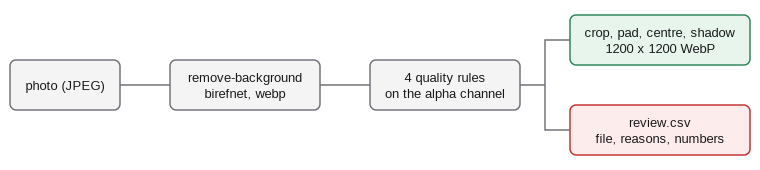
POST /v1/remove-background,model: birefnet,options: {output: "cutout", format: "webp"}。WebP 抠图比 PNG 小约 10 倍。每张 1 credit,缓存不打折。- 对 alpha 通道做四条规则检查(见下一节)。
- 通过的抠图按 alpha 外接框裁剪,缩放到留出 10% 边距的范围内,居中放在 1200 x 1200 的白底上,加柔和投影,存为 WebP。
- 不通过的写入
review.csv,附文件、原因和测得的数值。
各语言的安装与运行
以下命令针对冒烟数据集,在仓库根目录执行。冒烟数据集不需要 API 密钥,在免费层上运行;完整数据集需要密钥,设置上限后,客户端会拒绝可能超出上限的调用。
环境要求: Python 3.12, uv 0.5
cd use-cases/06-product-photo-pipeline/pythonuv sync --frozenuv run --frozen python main.py --manifest ../assets/smoke/manifest.json --out out
# 完整数据集: 完整数据集是仓库的发布附件,需要 API 密钥;解压后传入其 manifest。export FOLDBUN_API_KEY="fbs_..."export FOLDBUN_MAX_CREDITS=40uv run --frozen python main.py --manifest ../assets/full.json --out out
# 无需密钥:smoke 运行使用免费层。设置 FOLDBUN_API_KEY 后调用按标价扣费。cd use-cases/06-product-photo-pipeline/pythonuv run python main.py --manifest ../assets/smoke/manifest.json --out out --concurrency 4--resume 复用 out/cutouts/ 里已有的抠图,不重复调用。服务端返回 429 时,客户端按 Retry-After 等待后继续。退出码:0 完成(部分条目可能在 review.csv 里),1 失败,2 没有密钥(完整集需要密钥),3 密钥无权使用某个模型(403 model_locked),4 额度上限(FOLDBUN_MAX_CREDITS)拒绝了调用。完整集(40 张,按标价 40 credits)是发布资产,见 assets/full.json;它需要 FOLDBUN_API_KEY。用 uv run python evaluate.py --result out/result.json --truth assets/truth.json 给一次运行打分。
每个阈值都是具名常量,在完整集的 40 张照片上定下;规则拦下了其中多少张见「实测」一节。
- 覆盖率(
MIN_COVERAGE5%、MAX_COVERAGE90%,按 alpha 不低于 128 的像素占画面的比例):过低说明模型什么都没找到,过高说明把背景也留下了。 - 贴边(
EDGE_BAND取画面外缘 1%,EDGE_TOUCH_MAX为一条边的 3%):商品碰到画面边缘就是被照片截断了,抠图无法恢复缺掉的部分。 - 半透明占比(
MAX_SEMI_SHARE:非背景像素中 alpha 在 16 到 240 之间的占 10%):边界又宽又软说明模型拿不准,常见于玻璃和反光。 - 连通块数(
MIN_COMPONENT_SHARE:小于前景 2% 的块算杂点;在缩到 256 px 的副本上计数):多于一块通常意味着多件商品,或商品被切成两半。
源码: python/pipeline.py (在新标签页打开)
# Quality rules. Every number is a named constant so a catalogue team can tune it. They were set on the 40 photos of the# full set; expected/full-summary.json records how many of them the rules stop.FOREGROUND_ALPHA = 128 # alpha at or above this is "the product" (half opaque)SEMI_LOW, SEMI_HIGH = 16, 240 # alpha strictly between these is "semi-transparent" (neither background nor solid)MIN_COVERAGE, MAX_COVERAGE = 0.05, 0.90 # share of the frame the product fills: outside means a missed or a swallowed subjectEDGE_BAND = 0.01 # the outer 1 percent of each side (at least 2 px) is the frame edge ...EDGE_TOUCH_MAX = 0.03 # ... and the product may cover at most 3 percent of that side before it counts as cut off by the frameMAX_SEMI_SHARE = 0.10 # semi-transparent pixels as a share of all non-background pixels: above this the boundary is uncertainMIN_COMPONENT_SHARE = 0.02 # a connected piece smaller than 2 percent of the foreground is a speck, not a second productCOMPONENT_SIDE = 256 # connected pieces are counted on a copy scaled down to this long side (specks vanish, cost is bounded)源码: python/pipeline.py (在新标签页打开)
def coverage_and_semi(alpha: Image.Image) -> tuple[float, float]:    """Foreground share of the frame, and semi-transparent share of everything that is not background (one histogram)."""    hist = alpha.histogram()    total = alpha.width * alpha.height    foreground = sum(hist[FOREGROUND_ALPHA:])    semi = sum(hist[SEMI_LOW + 1 : SEMI_HIGH])    visible = sum(hist[SEMI_LOW + 1 :])    return foreground / total, (semi / visible if visible else 0.0)
def edge_touch(alpha: Image.Image) -> float:    """The largest share of one frame side that the foreground covers, looking at the outer EDGE_BAND of the frame."""    w, h = alpha.size    binary = alpha.point(lambda a: 255 if a >= FOREGROUND_ALPHA else 0)    bx, by = max(2, round(w * EDGE_BAND)), max(2, round(h * EDGE_BAND))    bands = [        (binary.crop((0, 0, w, by)), (w, 1)),        (binary.crop((0, h - by, w, h)), (w, 1)),        (binary.crop((0, 0, bx, h)), (1, h)),        (binary.crop((w - bx, 0, w, h)), (1, h)),    ]    shares = []    for band, size in bands:        line = band.resize(size, Image.BOX)  # a pixel is lit when any pixel of its row or column in the band is foreground        shares.append(sum(1 for v in line.tobytes() if v) / (size[0] * size[1]))    return max(shares)
def count_pieces(alpha: Image.Image) -> int:    """Connected pieces (8-neighbourhood) of the foreground, ignoring specks below MIN_COMPONENT_SHARE of the foreground."""    scale = COMPONENT_SIDE / max(alpha.size)    small = alpha.resize((max(1, round(alpha.width * scale)), max(1, round(alpha.height * scale))), Image.BOX) if scale < 1 else alpha    w, h = small.size    fg = bytearray(1 if v >= FOREGROUND_ALPHA else 0 for v in small.tobytes())    sizes = []    for start in range(w * h):        if not fg[start]:            continue        fg[start], stack, n = 0, [start], 0        while stack:            p = stack.pop()            n += 1            x, y = p % w, p // w            for ny in range(max(0, y - 1), min(h, y + 2)):                for nx in range(max(0, x - 1), min(w, x + 2)):                    q = ny * w + nx                    if fg[q]:                        fg[q] = 0                        stack.append(q)        sizes.append(n)    total = sum(sizes)    return sum(1 for n in sizes if n >= MIN_COMPONENT_SHARE * total)
def assess(alpha: Image.Image) -> Quality: """Apply the four rules to an 8-bit alpha channel. `reasons` is empty when the cut-out may go into the catalogue.""" coverage, semi = coverage_and_semi(alpha) touch = edge_touch(alpha) pieces = count_pieces(alpha) reasons = [] if coverage < MIN_COVERAGE: reasons.append("coverage_low") if coverage > MAX_COVERAGE: reasons.append("coverage_high") if touch > EDGE_TOUCH_MAX: reasons.append("edge_cut") if semi > MAX_SEMI_SHARE: reasons.append("semi_transparent") if pieces > 1: reasons.append("multiple_pieces") return Quality(coverage, touch, semi, pieces, reasons)def fetch_cutout(client: sc.StackClient, image_path: Path, item_id: str, out: Path, resume: bool) -> tuple[bytes, list[dict]]: """The WebP cut-out of one photo and the ledger rows of the call (none when it is read back from an earlier run).""" cached, state = out / "cutouts" / f"{item_id}.webp", out / "state" / f"{item_id}.json" if resume and cached.exists() and state.exists(): return cached.read_bytes(), json.loads(state.read_text())["calls"] body = {"model": "birefnet", "image": sc.image_base64(image_path.read_bytes()), "options": {"output": "cutout", "format": "webp"}} result = client.post("/v1/remove-background", body, tag=item_id) # retries, rate limits and the credit cap live in the client data = base64.b64decode(result["data"]) cached.parent.mkdir(parents=True, exist_ok=True) state.parent.mkdir(parents=True, exist_ok=True) cached.write_bytes(data) calls = client.calls(item_id) state.write_text(json.dumps({"calls": calls})) return data, calls源码: python/pipeline.py (在新标签页打开)
def compose(cutout: Image.Image) -> Image.Image:    """Crop to the alpha bounding box, fit inside the padded canvas, centre on white and add a soft shadow."""    box = cutout.getchannel("A").point(lambda a: 255 if a > SEMI_LOW else 0).getbbox()    if box is None:        raise ValueError("the cut-out is empty")    product = cutout.crop(box)    inner = round(CANVAS * (1 - 2 * PADDING))    scale = inner / max(product.size)    product = product.resize((max(1, round(product.width * scale)), max(1, round(product.height * scale))), Image.LANCZOS)    x, y = (CANVAS - product.width) // 2, (CANVAS - product.height) // 2    shadow = Image.new("L", (CANVAS, CANVAS), 0)    shadow.paste(product.getchannel("A").point(lambda a: round(a * SHADOW_OPACITY)), (x, y + round(CANVAS * SHADOW_OFFSET)))    shadow = shadow.filter(ImageFilter.GaussianBlur(CANVAS * SHADOW_BLUR))    page = Image.new("RGB", (CANVAS, CANVAS), "white")    page.paste(Image.new("RGB", (CANVAS, CANVAS), "black"), (0, 0), shadow)    page.paste(product, (x, y), product)    return page
def encode_webp(page: Image.Image) -> bytes: out = io.BytesIO() page.save(out, "WEBP", quality=WEBP_QUALITY) return out.getvalue()evaluate.py 在 40 张照片上对照 Open Images 的实例掩码打分:抠图 alpha(按 128 二值化)与真值的 IoU(均值和 P10)、质检拦下的比例,以及「被拦截」对「IoU 低于 0.85」的混淆矩阵,用来说明规则能否抓住真正有问题的抠图。运行不记录耗时:数字取决于客户端的网络路径,所以不发布。
| 指标 | 数值 |
|---|---|
photos |
40 |
iou_mean |
0.8812 |
iou_p10 |
0.6377 |
review_rate |
0.25 |
wrong_cutouts |
9 |
confusion.stopped_wrong |
4 |
confusion.stopped_fine |
6 |
confusion.passed_wrong |
5 |
confusion.passed_fine |
25 |
rules_precision |
0.4 |
rules_recall |
0.4444 |
by_kind.normal.photos |
28 |
by_kind.normal.stopped |
2 |
by_kind.normal.wrong |
6 |
by_kind.truncated.photos |
4 |
by_kind.truncated.stopped |
4 |
by_kind.truncated.wrong |
2 |
by_kind.multi.photos |
4 |
by_kind.multi.stopped |
4 |
by_kind.multi.wrong |
1 |
by_kind.thin.photos |
4 |
by_kind.thin.stopped |
0 |
by_kind.thin.wrong |
0 |
hard_cases_stopped_rate |
1 |
other_photos_stopped_rate |
0.0625 |
cost_per_1000_images_list |
1000 |
怎么读这次录制的结果:
- 8 张按设计属于难例的照片(4 张被画面截断、4 张含多件商品)全部被规则拦下;其余 32 张里拦下 2 张。4 张带细长结构的商品一张也没被拦,抠图也都没有问题。
- 混淆矩阵比实际的目录要求更严。Open Images 的掩码只覆盖被标注的那个物体,所以把杯子下面的碟子一起留下、或把叠在一起的两个玩具都留下的抠图 IoU 偏低,但这正是目录想要的结果;5 张「放行但有问题」里有 3 张属于这种情况。另外 2 张是真的漏检:一张带进了一条背景,一张被反光切碎。这两种规则都看不出来;IoU 低要有真值才能知道,而生产运行没有真值。
- 被拦下的 10 张里有 6 张 IoU 是好的。其中 4 张是含多件商品的照片:抠图没错,但照片本身不是一张目录图,
multiple_pieces规则就是为此而设。
每张 1 credit(1,000 credits 折合 1 美元,即每张 0.001 美元),1,000 张是 1,000 credits。这个端点缓存不打折;质检和合成都在本地运行,不花钱。smoke 运行在免费层上免费(运行时会打印标价并标注“免费层,不扣费”);带密钥的运行按此扣费,重跑会再次扣费,除非用 --resume。
| 运行 | 调用次数 | 标价(credits) | 实扣(credits) |
|---|---|---|---|
| smoke | 3 | 3 | 3 |
| full | 40 | 40 | 40 |
局限与不适用的场景
Section titled “局限与不适用的场景”- 一张照片里有多件商品时只能整体抠出。
multiple_pieces规则会把它送去复核;只要其中一件时,先用sam3加文字提示选出物体再抠。这个组合这里没有实现。 - 透明和反光的商品(玻璃、抛光金属)边缘不稳定,预期会出现在
review.csv里。 - 被画面截断的商品无法修复,规则只负责发现。
- 每张 1 credit,缓存不打折:使用密钥时,积压量大是一笔实打实的费用。
- 阈值只在 40 张家居物品照片上定过;用你自己的目录再核对一遍。
40 张 Open Images V7 验证集照片(CC BY 2.0,逐文件署名见 assets/ATTRIBUTION.csv),内容是杯子、碗、瓶子、相机、玩具、吉他、家具和家电,以 CC BY 4.0 的实例掩码为真值:28 张居中的普通商品,12 张难例(4 张被画面截断、4 张多件商品、4 张带细结构)。含人物、人脸、车牌、水印或大幅品牌字样的照片已人工剔除。一张图有多个实例时,真值取它们掩码的并集。冒烟集是这 40 张里的 3 张。权利人如需移除某张图片或某个数据集,可通过联系页面 (在新标签页打开)提出。